
NEXT Monday, January 20, Inland Rail will start a series of field investigations across the Narrabri to North Star Phase 2 section.
Planned activities include soil erosion testing, geotechnical investigations, biodiversity surveys and flood-level surveys.
Soil erosion testing will be conducted at four locations along the alignment north of Moree, with work expected to take one week, weather permitting.
Soil erosion testing, also known as Erosion Threshold Velocity testing, is a study of soils, to determine whether they could possibly be eroded by overland water flows.
“ETV testing helps us understand how soil reacts to water flows over land where Inland Rail will be built,” Inland Rail’s fact sheet says.
“This data, along with other hydrology technical studies and analysis, helps inform our designs, particularly for bridges and cross-drainage structures.
“Our goal is to design a safe and reliable rail line that minimises, wherever possible, the impact Inland Rail may have on local water flows and flood behaviour.”
Work also includes superficial soil sampling and testing on-site, using hand tools, undisturbed soil sample collection involving pushing sampling frames with a small excavator through a small trench to collect samples with an ‘undisturbed’ surface for testing in a laboratory.
“A small soil sample – approximately a 10kg bag – is collected from the testing location. It is analysed on-site and in a laboratory to determine soil classification, soil density and shear stress. Two to four people – depending on site conditions – will access the testing location by light vehicle and on foot.”
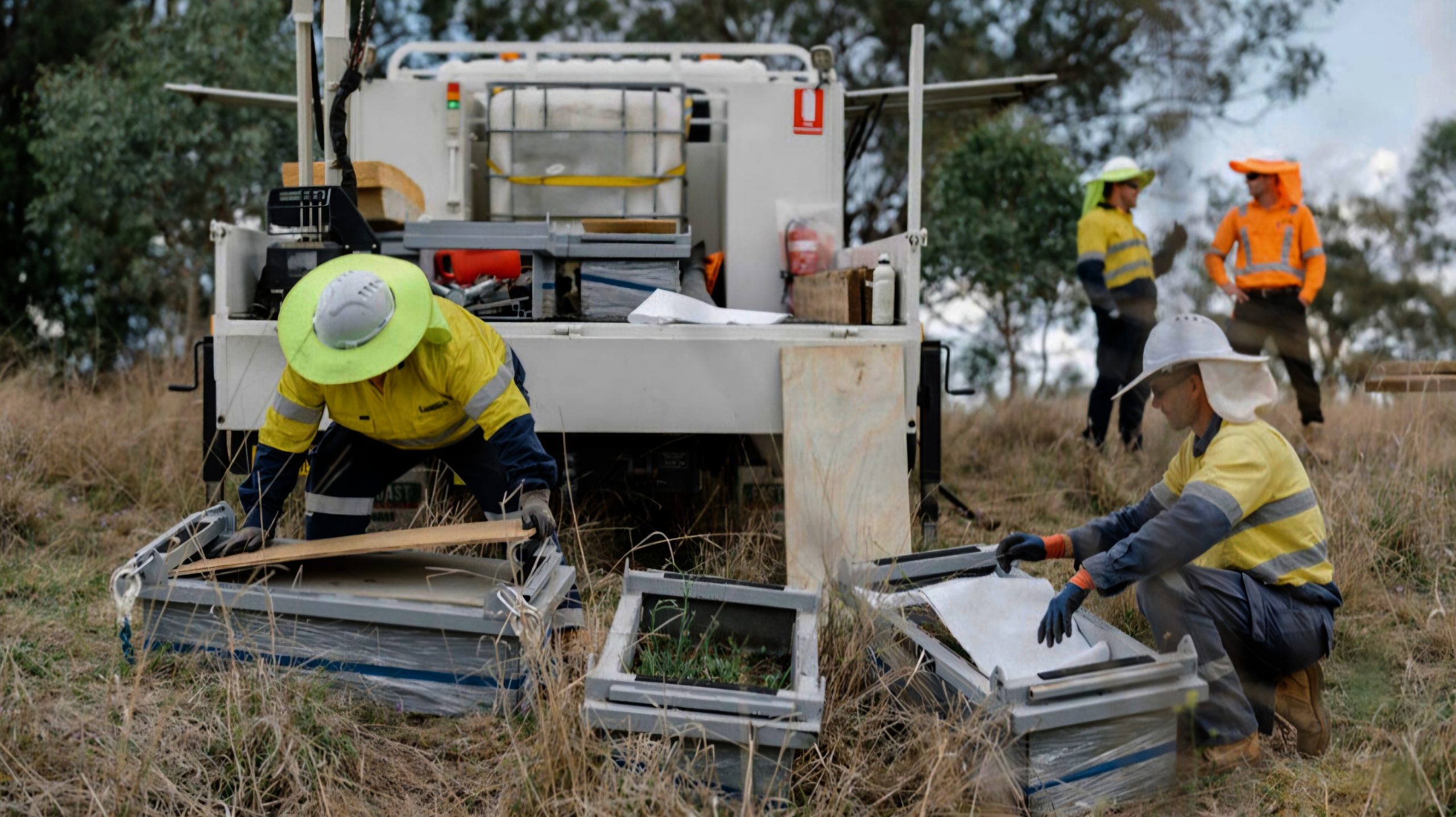
Inland Rail staff pack up soil erosion samples (Image: Inland Rail).
Inland Rail was last year recognised by the Infrastructure Sustainability Council with an ‘Excellent’ As Built rating for the Narrabri to North Star Phase 1 project.
The Phase 1 project impressed the Sustainability Council with several key achievements along its 176 kilometres of upgraded track, which makes it the longest linear infrastructure project certified by the ISC.
Among the upgrades were improvements to seven bridges and increased safety at 57 level crossings, with 10 passive level crossings upgraded to active with bells, lights, and boom gates installed at the crossing.
The Narrabri to North Star Phase 1 upgrades deliver a more efficient and reliable railway for local producers, boosting resilience against extreme weather events, with the track withstanding the worst flood in a decade to hit Moree in 2022.
More than 2000 people worked on the project, including 678 locals of whom 185 were First Nations residents.
Inland Rail Executive Director of Health, Safety, Environment and Sustainability, Stephen Jones, was honoured to collect the award.
“It was an honour for us to be able to collect this certificate on behalf of Inland Rail in front of our peers across the infrastructure industry,” Mr Jones said.
“The ‘Excellent’ As Built rating demonstrates the levels of commitment to sustainability we hold dear at Inland Rail where a team of professionals dedicate themselves to achieving excellence in this key field.
“The Narrabri to North Star project is yet another example of Inland Rail’s ongoing commitment to sustainability, innovation, and industry leadership.”
Spanning more than 1600km, Inland Rail is the largest freight rail project in Australia and one of the most significant rail infrastructure projects in the world.
The Inland Rail project comprises 12 individual sections across 30 local government areas, with one section in Victoria, seven in New South Wales and four in Queensland.
The project will upgrade 1000km of existing rail line and build 600km of new track to connect Melbourne and Brisbane via regional Victoria, New South Wales and Queensland and will cut rail freight travel time between Melbourne and Brisbane by almost a third – down from 33 hours to less than 24 hours – making it competitive with road use.
Inland Rail will provide a consistent standard gauge connection from Melbourne to Brisbane as well as a dual gauge connection in Queensland, to allow seamless connectivity with Queensland’s narrow-gauge network.


